Hey, User !
Hey, User !
Welcome to SayaCare- India's only E-pharmacy that Tests every Batch👋FREE delivery on 1st order — Use coupon: TESTME101


Corruption in drug regulation erodes trust and health by allowing substandard medicines.

Content Writer
Published on 7-8-2026
•7 min read
Table of Contents
Young Indians think diabetes happens after 40, but this is not true. The prevalence rate of pre-diabetes in India is 15.3%, and this does not mean we can’t be next in line for it, because lifestyle and environment do affect blood sugar levels. We usually don’t know when we should get our blood sugar tested, and in fact, even people with diabetes don’t know at what frequency they should be testing. To get the answer to your question, read this blog till the end.
There are four different tests for diabetes which are as follows:
Conducted in a laboratory. This test gives your blood sugar result for the past 3 months.
This test is conducted by a doctor after the patient has done 8 hours of fasting. Meaning have dinner at night, sleep for 8 hours, don’t have anything except water, and then do your blood sugar test.
After an overnight fasting of 8 hours, you are asked to drink a solution containing 75 gm of sugar, and after 2 hours of consuming it, your blood sugar is tested.
This can be done at any time, irrespective of consumption of food.
Click here to check: 1. SayaCare’s Digital glucometer with 50 test strips and lancets
You can do any test every 3 months, and not just a blood sugar test. This is because every 3 months your new blood cells, also known as red blood cells, are formed. Every three months is not necessary though, the frequency of testing is based on your age, stress levels, and your disease.
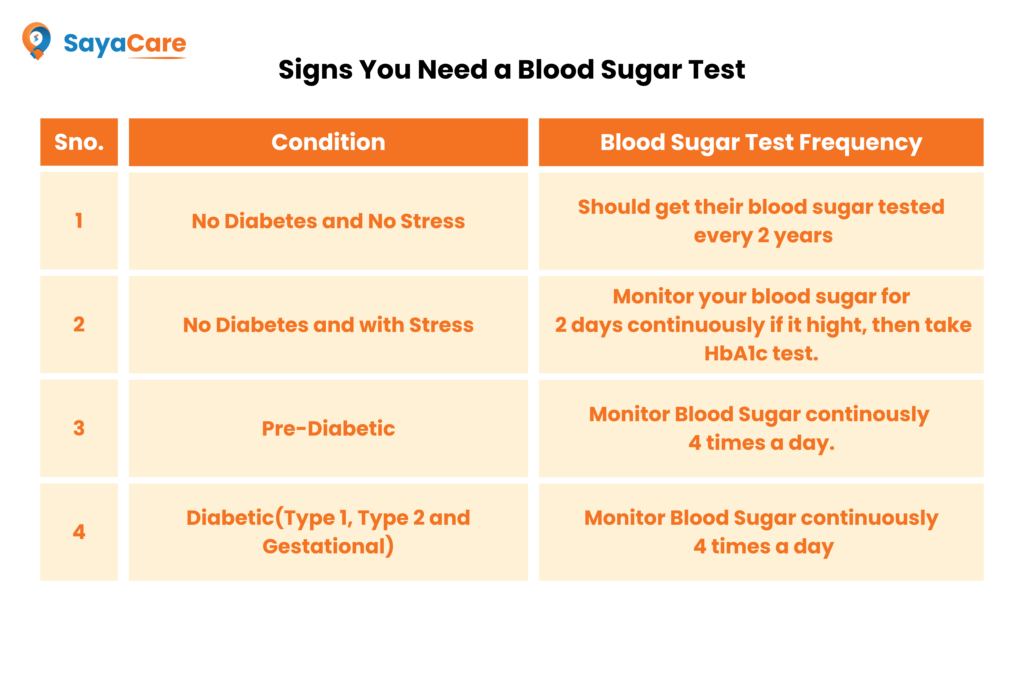
Following are the situations when and at what frequency one should get their blood sugar tested based on their age and disease condition:
If you live a stress-free life and you are in your 20s, get your blood sugar tested every 2 years.
If you have no prior disease but your life is full of stress, then yes, stress increases blood sugar disease risk [1] Young Indians who are working usually carry a lot of stress, and while there’s no exact data on how much it affects blood sugar, it does increase blood sugar levels. This is because stress activates your body’s fight or flight system, which releases adrenaline and cortisol (known as stress hormones). These hormones then release the blood sugar stored in your liver, which raises your blood sugar level [2]. A stressful life doesn’t just impact your mental health, it impacts your whole body.
Currently, the trend is that anyone can be pre-diabetic, irrespective of age group. A pre-diabetic person can be diagnosed with a glucometer, the device generally used at home, by continuously monitoring their blood sugar level for at least 2 days, 3 to 4 times a day.
Once after waking up, next 15 minutes before eating, and again 2 hours after each meal. Once these 2 days of continuous monitoring make it clear that you may be diabetic, get your HbA1c tested, as it will show your blood sugar levels over the past 3 months. If the result comes back positive, you need to consult a doctor.
A person with diabetes should continuously monitor their blood sugar level daily, 3 to 4 times a day. Once after waking up, once 15 minutes before food, and once 2 hours after eating.
SayaCare recently held a health checkup camp in a mall, where we were monitoring blood sugar, blood pressure, and weight. We came across many non-diabetic people getting their blood sugar tested. People with diabetes who were already on medication had blood sugar levels as high as 500 mg/dl despite taking insulin and diabetic medication, and they had simply come to accept it as normal.
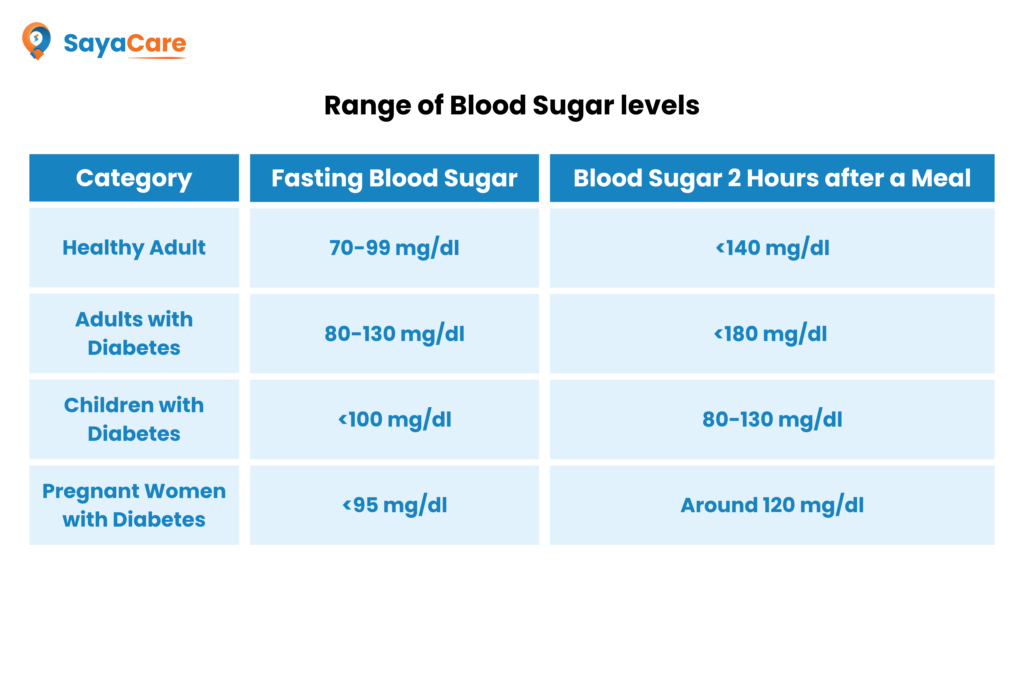
Even with medication, blood sugar should ideally fall between 80 to 130 mg/dl pre-fasting, or under 180 mg/dl 2 hours post-meal. Levels above that are a clear sign that the medication isn’t working properly, or that doctor’s instructions are not being followed closely. No one should treat a reading above 200 mg/dl as normal, they should consult their doctor or consider switching doctors.
Explore SayaCare’s : Diabetic Medicine Range
Blood sugar level range depends on your age and your conditions. Following are the conditions for which your blood sugar level will be considered normal:
There are 9 factors for a rise in blood sugar levels, which are as follows:
Junk food is rich in carbohydrates, and carbohydrates are the main reason for a rise in blood sugar as they get digested easily and cause blood sugar to spike.
When you are inactive, your muscles don’t need energy (sugar) for functioning, which increases the level of sugar in your blood.
Medications like steroids and antipsychotic drugs tell the liver to produce more sugar and release it into the blood, while also blocking the action of insulin.
When you are ill, your stress hormones get triggered, which results in the liver releasing more sugar into the blood.
Stress causes the release of stress hormones that trigger the liver to produce more sugar and release it into the blood.
Sunburn causes physical pain and skin damage that results in stress and the release of inflammatory hormones, which can lead to the liver producing and releasing more sugar [3]
The two weeks prior to your period is the luteal phase, where a woman’s body releases a hormone called progesterone. This hormone blocks the action of insulin[4]
Dehydration reduces the volume of blood and increases the concentration of sugar in the body, resulting in a rise in blood sugar [5]
Blood sugar testing is not a one-size-fits-all routine. How often you should get tested depends on your age, stress levels, lifestyle, and whether you already have a diagnosis. Someone in their 20s living a stress-free life can go two years between tests, but a diabetic person needs to check multiple times a day. The key takeaway is simple: don’t assume you’re too young to be at risk, and don’t assume one test result means you’re set for life. Get tested at the frequency that matches your actual condition, keep track of your numbers, and if something feels off or your readings stay high despite medication, don’t normalize it, talk to your doctor.
Also Read: 1. What should you eat, and how, to lower your blood sugar levels?
3. What is the Glycemic Index, and how is it helpful in managing blood sugar levels?
Ans: If you are diabetic, you can monitor your blood sugar daily, at least 4 times, using a glucometer: before eating, 2 hours after eating, and before bedtime. Monitoring through a glucometer will also help you know whether your medicine is working or not. If you want to do the HbA1c lab test, you can do it every 3 months, since new blood cells are formed every 3 months.
There are four different types of blood tests for diabetes diagnosis, which are: 1. Glycosylated Hemoglobin (HbA1c) test, which detects blood sugar levels over the past three months; 2. Blood Sugar Test, which can be done at home using a glucometer; 3. Oral Glucose Tolerance Test (OGTT), done 2 hours after consuming a 75 gm sugar solution.
Table of Contents