Hey, User !
Hey, User !
Welcome to SayaCare- India's only E-pharmacy that Tests every Batch👋FREE delivery on 1st order — Use coupon: TESTME101


जानिए साया केयर के सफर 👣 को संस्थापक ध्रुव माथुर गुप्ता के शब्दों में।

Content Writer
Published on 28-8-2026
•6 min read
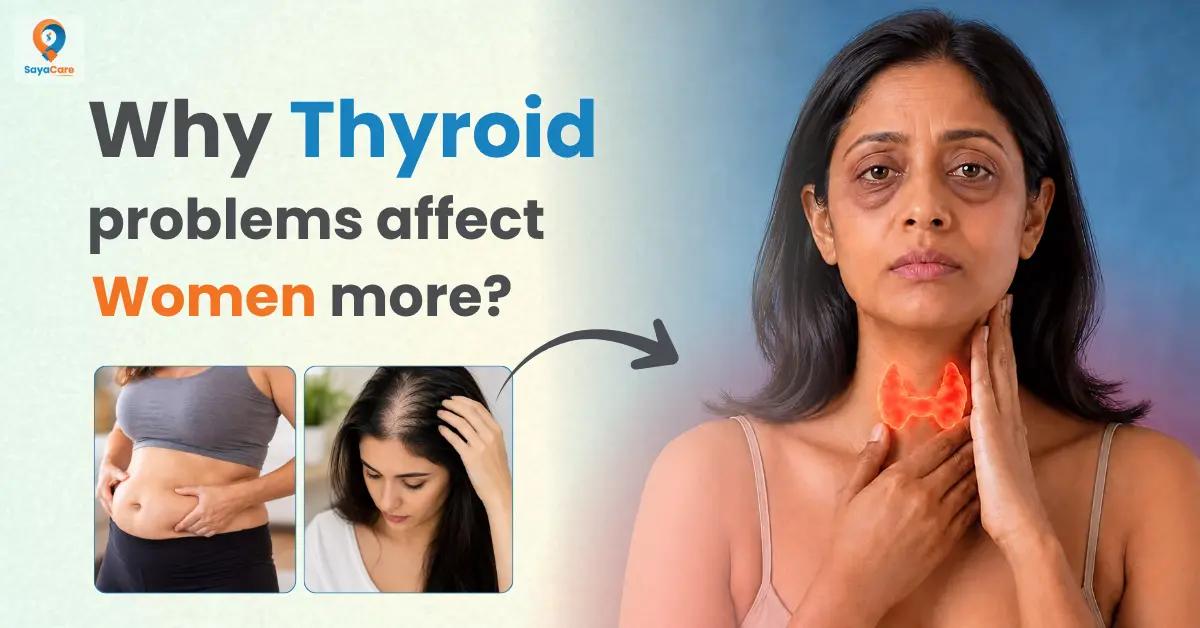
Table of Contents
Have you ever noticed how almost every woman you know either has thyroid issues or knows someone who does? Turns out, it’s not just a coincidence. As per National Health Family Welfare report (2019-2021), women are 5 times more affected by these conditions compared to men, and the prevalence of thyroid disease in Indian women stands at 11-15%. This points to something rooted in a woman’s biology itself. So what exactly is going on inside a woman’s body that makes her more prone to thyroid issues? Read this blog till the end to find out.
When the thyroid gland in our body secretes too little or too much thyroxine (T4) or triiodothyronine (T3), it results in a hormonal condition. The thyroid is a butterfly-shaped gland that releases the hormones T3, T4, and calcitonin. These conditions can be autoimmune (when the body attacks the gland) or caused by external factors (like low iodine intake, etc.)
Thyroid control many of our bodily functions, below is a list of what it does:
It controls your weight, temperature, and energy.
Thyroid gland regulates heart rate and heartbeat.
In children, thyroid hormones are important for normal growth and brain development.
Thyroid hormones help the body produce heat and keep body temperature stable.
Click to check Thermometer.
influences muscle strength and food movement through the digestive system.
The thyroid gland also releases a hormone called calcitonin, which helps control calcium levels in the blood and supports bone health.
Observe your body and if you notice any unexplained changes in these areas, then get your thyroid tested.
A Woman’s body in general is the main reason why thyroid disease is more common in women, irrespective of environmental factors or autoimmune disease. This holds true for both hypothyroidism and hyperthyroidism, women are more prone to either condition compared to men [1,2]:
Women generally have a stronger immune system, which improves their response to infections and vaccines. But this can also work against them, as the immune system may start attacking their own thyroid gland.[3]
Estrogen helps control the immune system. In women who are already prone to autoimmune disease, changes in estrogen levels may cause the immune system to lose tolerance and react against thyroid proteins. This can lead to inflammation, and gradually thyroid damage.
Genetics also play a role in thyroid disease, a family history can trigger it
During pregnancy, many changes occur in the body, not just from the outside but from within, as the body gears up to provide for the fetus. Because of these changes, the body demands more thyroid hormone for a few reasons:
During pregnancy, a woman’s immune system holds back from harming the fetus. Once the baby is delivered, the immune system can relapse and attack the thyroid gland again.
Falling estrogen during menopause does not usually mean the thyroid cannot meet the body’s needs. TBG may decrease, but free thyroid hormone is mainly controlled by the TSH feedback system. Thyroid disease may become noticeable at this age because autoimmune disease risk increases with age, and its symptoms can resemble menopause.
A disease where your immune system starts attacking your thyroid gland. This attack can be triggered by a few reasons:
In this condition, the thyroid cells that store hormones become inflamed, leading to the release of hormones into the blood.
Inflammation of the thyroid gland that occurs within 1 year after giving birth.
In this condition, the antibodies signal the thyroid gland to release more thyroid hormone than needed.
Smoking increases the risk of autoimmune thyroid disease, as the immune system mistakes it for a foreign particle.
Infectious or non-infectious substances can activate the immune system and result in thyroid disease
Too little iodine can result in hypothyroidism, while too much can result in hyperthyroidism
Radiation, including ionizing radiation and non-ionizing radiation like radiofrequency or microwaves, can result in thyroid disease.
Several medicines, such as those used to treat HIV or control viral infections, can cause thyroid issues.
A thyroid test is a simple blood test that checks three hormones TSH (Thyroid Stimulating Hormone), T4, and T3 to see how well your thyroid is working. Doctors usually recommend this test if you are experiencing symptoms like unexplained weight change, fatigue or mood swings or if thyroid disease runs in your family [5]:
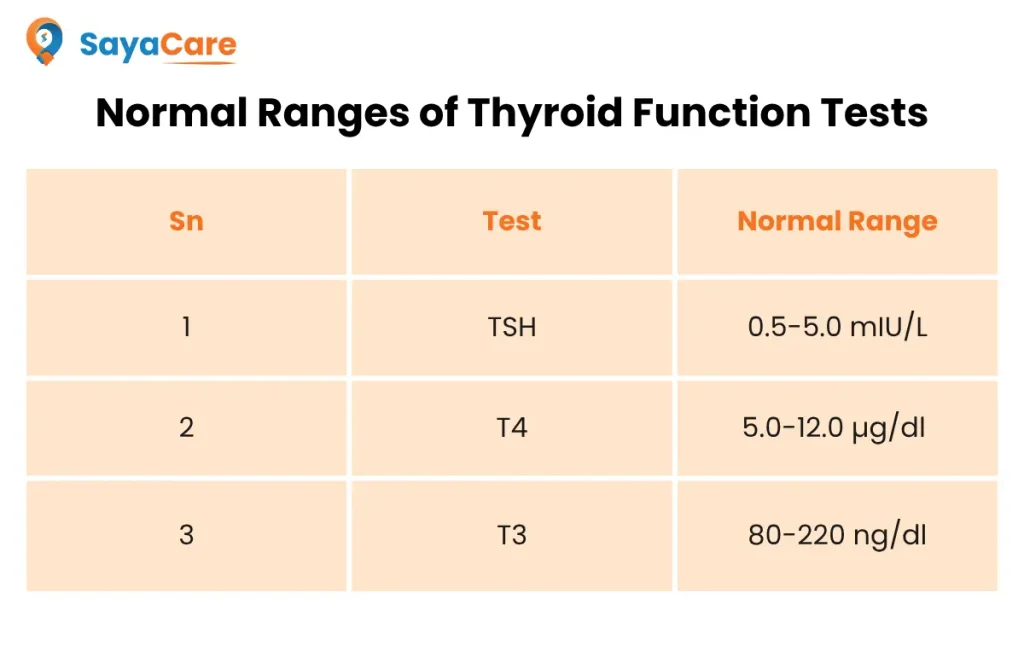
If your levels fall below or above this range, its a sign to consult a doctor for further evaluation and treatment.
Thyroid disease cannot always be prevented, but it can be managed well with the right steps. Here is how you can manage thyroid:
Doctors usually prescribe hormone replacement medicines like levothyroxine for hypothyroidism, or anti-thyroid medicines for hyperthyroidism. Taking these on time and as prescribed helps keep hormone levels in the normal range.
Click here to check out hypothyroidism and hyperthyroidism range.
Getting your TSH, T3, and T4 levels checked regularly helps track how the thyroid is responding to treatment, so the dosage can be adjusted if needed.
Eating iodine-rich foods like fish, eggs, and dairy can help support the thyroid, but too much iodine should also be avoided. In case of Hashimoto’s, some people also benefit from reducing gluten and processed foods.
High stress can affect hormone balance, so activities like yoga, meditation, or light exercise can help keep the thyroid function stable.
Getting proper sleep is important as poor sleep can disturb hormone regulation, including thyroid hormones.
Click to buy sleep medication range.
Since smoking increases the risk of autoimmune thyroid disease, quitting smoking can help lower flare ups.
Click to buy nicotine gums.
Since thyroid disease can change over the years, especially during pregnancy or menopause, regular checkups with a doctor help catch changes early.
Also Read:
2- Why modern Medicine are Not for Women?
Thyroid disease is more common in women due to a mix of biology, hormones, genetics, and life stages like pregnancy and menopause. The thyroid gland plays a key role in regulating metabolism, heart function, and overall energy, so any imbalance in its hormones can affect day-to-day health.
Table of Contents