Hey, User !
Hey, User !
Welcome to SayaCare- India's only E-pharmacy that Tests every Batch👋FREE delivery on 1st order — Use coupon: TESTME101


आपके स्वास्थ्य को परीक्षित विकल्पों की आवश्यकता है — साया केयर दोनों, सुरक्षा और बचत 💸, प्रदान करता है।

Content Writer
Published on 18-5-2026
•4 min read

Table of Contents
Mango is often called the “King of fruits” in India because of its sweet taste, but because of its sweetness, many believe that mango can spike blood sugar levels. This fear often forces diabetic patients to avoid it. But caught between taste and health, a lingering question remains: can diabetic patients eat mango?
To get the answer, I explored human studies examining the relationship between mango and blood sugar. The results were surprising. In this blog, we will understand how sweetness cannot be directly associated with causing diabetes; one needs to understand its composition and, more importantly, its glycemic index. Read on to explore more.
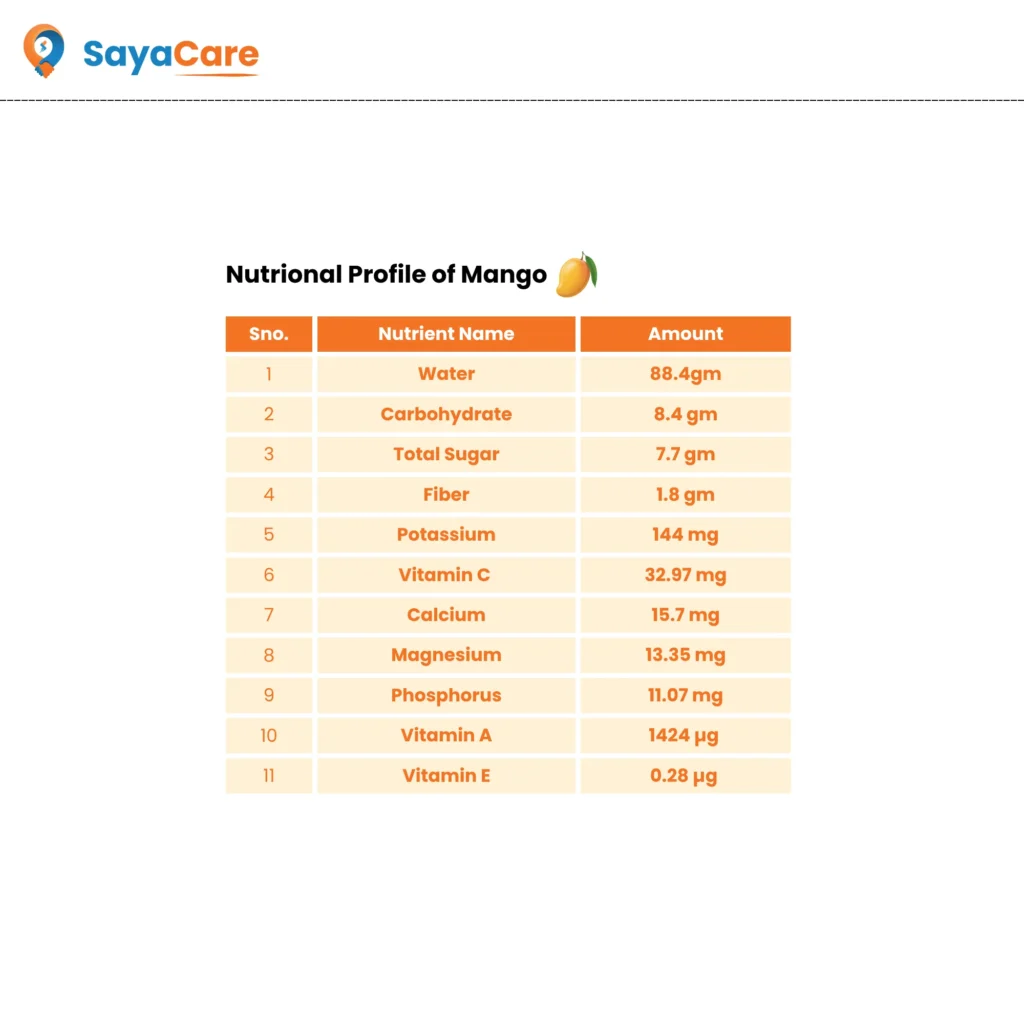
Since mangoes are sweet, they are often associated with a high blood sugar spike. Interestingly, despite tasting very sweet, mango contains a high amount of water (88.4 gm) and only 7.77 gm of sugar per 100 gm. [1]
This is opposite to what most people generally assume about mango.
If sweetness cannot be relied upon to understand the blood sugar spike caused by a food, then what should be considered? The answer lies in its carbohydrate content and glycemic index (GI).
Doctors often suggest eating foods that are low in carbohydrates, and in the case of mango, the carbohydrate content is only 8.4 gm per 100 gm.
People with diabetes should monitor their carbohydrate intake and avoid consuming more than 15 gm of carbs per 100 gm of food.
The American Diabetes Association also advises diabetic patients to be mindful of foods with higher carbohydrate content.
Below is Mango Nutrient profile [2]
The second way to understand the blood sugar spike caused by a food is through its Glycemic Index (GI). GI measures how quickly a food impacts glucose levels after eating.
Click To Read: About Glycemic Index, Diabetes Reversal: Scam or Reality
Below is the Glycemic index range:
Mango fruit has a glycemic index of 48, indicating that it is a low GI fruit.
This means mangoes are digested and absorbed more slowly, reducing the chances of a sudden spike in blood sugar levels when eaten in moderation.
In the above two topics, the answer to the question “Can a diabetic eat mango?” was explained through the nutritional composition and glycemic index of the fruit.
Real-world studies and results on the effect of mango on human blood sugar levels are described in the next section, which is……..
To find the definitive answer, I delved into human studies to know the effect of mango consumption on blood sugar levels. I analyzed two key studies: one national and one international. The international study focused on pre-diabetic participants, while the national study observed patients with stable Type 2 diabetes.
When compared to a standard carbohydrate food like bread, the results were consistent, as stated below:
To answer the question: yes, a diabetic person can eat mango, but it should be consumed in moderation, preferably not more than 50 g at a time.
Sweet does not always mean high blood sugar, which is clearly proved in the case of mango. A diabetic patient should be mindful of the carbohydrate content and glycemic index of food instead of judging it by sweetness alone. Mango not only has a low glycemic index and moderate carbohydrate content, but is also packed with nutrients that help fulfill nutritional deficiencies and provide several health benefits to the body.
Table of Contents