
Hey, User !
Hey, User !
Welcome to SayaCare- India's only E-pharmacy that Tests every Batch👋FREE delivery on 1st order — Use coupon: TESTME101




🔥722 People bought recently
Per unit price
₹ 2.4/gm
Quality Lab Tested
This batch has been verified!
lu fung cream
₹ 195
lulicon cream
₹ 375
luliconaz
₹ 149
lulicop cream
₹ 270
logifin cl
₹ 250
alerzim l cream
₹ 191
lunabet cream
₹ 125
luli od cream
₹ 139
luliazo
₹ 199
lz xl cream
₹ 209
You pay for the medicine, not the brand name
Lab Tested Quality
Transparent Test Report
| Uses | 1. To treat Interdigital Tinea Pedis (athlete’s foot) 2. To treat Tinea Cruris (Jock itch) 3. To treat Tinea Corporis (Ringworm of body) |
| Common Side Effects | 1. Mild stinging or burning 2. Itching or tingly feeling 3. Skin dryness, peeling, or flaking 4. Redness or other irritation. |
| Additional Information | 1. To be used for external application only 2. Wash hands after application to avoid accidental contact with eyes or mouth. 3. Luliconazole is occasionally used off-label for conditions like candidiasis and onychomycosis |
| Storage | 1. The medicine should be stored at room temperature. 2. Keep away from sunlight and moisture. 3. Keep away from the reach of children |
| How to Take This Medicine | The medicine should be applied to the affected area. |
Luliconazole 1% is a topical cream belonging to the class of antifungal creams and used for various types of fungal infections on skin caused by different fungi. The kinds of fungal infections that can be treated are given below:
Luliconazole works by blocking the fungus ability to make ergosterol, a key chemical necessary for the fungus to build its skin. but this cream stops the release of ergosterol, leading to weakening of fungus walls, so the fungus collapses and dies, which helps clear skin infections like athlete’s foot, jock itch, and ringworm.
It is considered safe to use during pregnancy.
If you have previously had an allergy to this medicine, inform your doctor.
Avoid applying it to open wounds, ulcers, or severely damaged skin because it can increase systemic absorption of steroids.
It is safe to use while breastfeeding.
Luliconazole does not interact with food products, as it can be applied on the skin only. So, it is safe to use without any fear of food interactions.
Avoid taking luliconazole with the following medicines, as it may increase or decrease the desired effect, or in worse cases, it could be fatal:
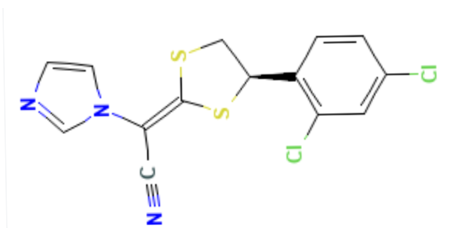
(2E)-(4R)-4-(2,4-dichlorophenyl) -1,3-dithiolan-2-ylideneacetonitrile
Take Luliconazole exactly as your doctor recommends. The dose may change based on your condition and how well you respond. Do not take more than prescribed without consulting your doctor.
If you forget to take your medicine, take the medication as soon as you remember. If it’s nearly time for your next dose, skip the missed one and continue with your regular schedule. Always consult the doctor before making any changes to your dosage.
Apply luliconazole suspension/cream as per doctor’s instructions; do not consume orally. If ingested orally by mistake, overdose symptoms may occur and include nausea, irritations, and vomiting; excessive skin application causes marks on skin and burning sensations.
Luliconazole is a prescription antifungal cream from the azole family, mainly used for athlete’s foot, jock itch, and ringworm, with doctors sometimes extending it to hand, face, scalp, nail, yeast, or pityriasis versicolor infections. It works by blocking the fungus ability to build up on skin. It is applied on the skin, So the organism weakens and dies. Apply luliconazole once a day, daily, on clean and dry skin. Sometimes it can cause mild burning, redness, or itchy skin, but serious reactions are rare. Since it’s only used on the skin, food and drug interactions are minimal; just avoid mixing with other strong medicated creams.
Luliconazole attacks the fungus on the skin by blocking its ability to build a strong protective wall. This weakens and kills the fungus, helping clear infections like athlete’s foot, jock itch, and ringworm.
Luliconazole is usually well tolerated, but it can sometimes cause mild skin reactions like redness, itching, burning, or dryness where it’s applied. These effects are generally short‑lived and settle on their own.
Yes, luliconazole cream can be applied to the groin or private parts if prescribed for fungal infections like jock itch. It should only be used externally on the skin, never inside the vagina, urethra, or rectum.
No, luliconazole is not a steroid; it is an antifungal medicine from the azole class. It treats fungal skin infections by weakening the fungus protective wall, not by reducing inflammation like steroids do.

Written By-
Siva Krishna Adithya BhumireddyMedical content writer
Bachelors in Pharmacy | 1+ Year experience

Reviewed By-
Mahak PhartyalMedical Content writer and reviewer
Bachelors in Pharmacy | 3+ Year experience
Last Updated: 28 Nov 2025
India's OnlyE- Pharmacy
That Tests Every Medicine Batch.
Tested hai, Toh bharosa hai!
Safe medicines
-Rigorously Tested-
Quality Reports
-Full Transparency-
Low Prices
-Save up to 80%-
Home Delivery
-Fast & Reliable-